
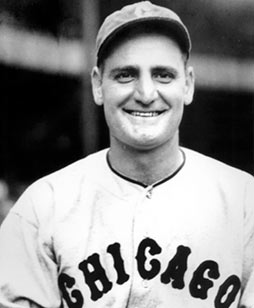
Henry "Zeke" Bonura
Sport: Baseball
Induction Year: 1989
Induction Year: 1989
In the 1925 national Amateur Athletic Union track and field championships in San Francisco , a 16-year-old New Orleans boy became the youngest male athlete ever to win an individual title.
The 213-foot, 10 ½ inch javelin throw by Henry Joseph Bonura was such a shocking performance—seven feet better than the winning toss in the “Chariots of Fire” Paris Olympics the previous year, and less that five feet under the world record—that meet officials decided it was too good to be true.
It wasn’t accepted as a meet or American record because it was wind-aided—a ruling that had track purists shaking their heads in disbelief. Legally, wind is a factor only in jumping and running events. It obviously affects the javelin and discus, but wind limits do not apply to those events.
Apparently, the officials felt Bonura’s age was also wind-aided. Al listing of the youngest national champions does not include him, although no other male champion in any event ever won a title before his 17th birthday.
“Zeke” Bonura excelled in football, basketball and track at St. Stanislaus, a Catholic military school in Bay St. Louis, Miss., and Loyola University. But he didn’t go into the Louisiana Sports Hall of Fame because of those sports.
Bonura was a major league baseball player for seven years. He drove in 704 runs and had a career batting average of .307. But long-suffering Chicago White Sox fans remembered his defensive misplays long after they forgot his base hits.
“It was never established beyond the shadow of a doubt that Bonura was the worst fielding first baseman in the majors,” long time Shreveport Journal sports editor Otis Harris wrote in 1946, “but the consensus was that he would do until another one came along.”
Bonura had 1,099 base hits, and hit more than 20 homeruns in three seasons. He had a total of 119 homers, and a career slugging percentage of .487.
He got his nickname “Zeke” from Notre Dame football coach Knute Rockne, who checked out Bonura’s broad shoulders and narrow waist and exclaimed, “What a physique!” It was shortened to “Zeke.” Bonura also was called “Bananas,” because his family was in the fruit produce business.
He had offers to play pro football and basketball, but baseball was Bonura’s first love. He started out with the New Orleans Pelicans, with his batting average ranging up to .375. Then he was old to Dallas of the Texas League, where White Sox talent scouts discovered him after he hit .322 and .337 in successive seasons.
Bonura was a cult hero of sorts in his four seasons with the White Sox. Cigar-chomping manager Jimmy Dykes called him “my pet ox,” but hastened to add, “You can’t help loving the guy.”
As a 25-year old rookie, Bonura hit .302 and had a team-high 110 runs batted in. White Sox fans figured those numbers made up for the runs Bonura gave up on defense.
In his fourth year with the White Sox, Bonura hit a major league career high .345, ranking fourth behind Hall of Famers Charlie Gehringer of Detroit and Yankees Lou Gehrig and Joe DiMaggio. Bonura also drove in 100 runs. His reward was to be traded to the Washington Senators for Joe Kuhel.
Although he was considered one of the worst defensive first basemen in the big leagues, Bonura had very few errors because he didn’t get a glove on balls that would be routine plays for other first basemen. Once, after Bonura feebly waved at a grounder, Dykes cornered catcher Luke Sewell.
“Could Bonura have gotten to that ball?” he asked.
“No,” said Sewell.
“You’re taking up for him!” Dykes screamed. “That would’ve been an easy play for anybody else!”
“You didn’t ask me about anybody else,” said Sewell. “You asked me about Bonura.”
When he traded Bonura to the Washington Senators, Dykes didn’t bother changing his signs for Chicago ‘s first series with the Senators.
“Why should I?” he asked “He didn’t know them when he was playing for us.”
The strategy backfired when Bonura, who was on third base, noticed Dykes wave his scorecard and charge to the plate—separating the catcher from the baseball.
“I saw him give the signal to steal,” he explained later, “ and I forgot that I wasn’t playing for the White Sox any more.”
Once, while he was playing with the Senators, fans cheered wildly when Bonura missed an easy grounder and the right fielder threw the ball back to him.
“What are they cheering that big lug for?” Senators owner Clark Griffith asked a fan. “He missed the ball.”
“Yeah,” he replied “but he got it on the way back.”
Everybody didn’t love Bonura. After he was traded to the Giants, Leo Durocher deliberately spiked him on a double play. Big “Zeke” threw the ball at Durocher, chased himinto right field and landed a few punches before the umpires separated them and threw both of them out of the game.
Bonura served in the Army Special Services during World War II, organizing 44 service teams in North Africa . His season was climaxed by the African World Series. He set up programs for kids in Italy and France , and organized football leagues, staging an Arab Bowl on New Year’s Day of 1944.
Bonura, who spoke fluent Italian, was asked to round up a band of Italian musicians to entertain the American troops. He not only organized a band, but taught it to play such popular American tunes as “You Are My Sunshine.”
General Dwight D. Eisenhower conferred the Legion of Merit award on Bonura, with Major General Arthur King present the medal.
“It was on Goat Hill,” Bonura recalled. ‘They had the troops drawn up and I was called out, and the general pinned the medal on me. I was so proud, I could have cried. I hadn’t fired a shot in the war and here I was getting a medal on Goat Hill. A lot of our guys died taking that hill.”
Like Dykes said, you couldn’t help loving the guy.

Recent posts
-
Louisiana Sports Hall of Fame announces star-studded 2027 induction class September 9, 2026

-
Hall of Famer Jerry Stovall passes away at age 85 August 31, 2026

-
Passing of a legend: LSU’s transformational Skip Bertman dies at 88 August 14, 2026


